
PCI Compliance--What Does it Mean?
A few years back the Payment Card Industry came up with a security standard. The idea was to have every merchant complete a list of questions verifying that they handle customer's credit card numbers and information in a secure way.
PCI Compliance process helps merchants keep their businesses secure. For example, if a business has a computer POS system handling their credit card transactions, PCI compliance requires a scan of the computers once a year and continuously updated security software. Keeping these things up to date prevents criminals from stealing your customers' card numbers. Just like locking the back door every night.
The annoying news is that non-compliant merchants are charged a monthly fee of $19.95. Please know that this is not a trumped up fee to pad ePOS' wallet. We don't receive this money. It goes to offset the risk of merchants who chose to ignore PCI security standards.
We want EVERY ePOS merchant compliant all the time. We are reaching out to our customers this month and helping everyone get compliant. Please, if you get an email from us, or from MyPCI.com, these are legitimate attempts to help you from your current merchant services company. Of course if you get a call or email from someone other than ePOS or MyPCI.com, kindly disregard.
PCI Compliance saves you money and protects you from liability. Please check your statement for PCI Non-complaince fees. Contact us. We will help you get compliant and prevent further costs imposed by the industry.
Jason Hanson, ePOS
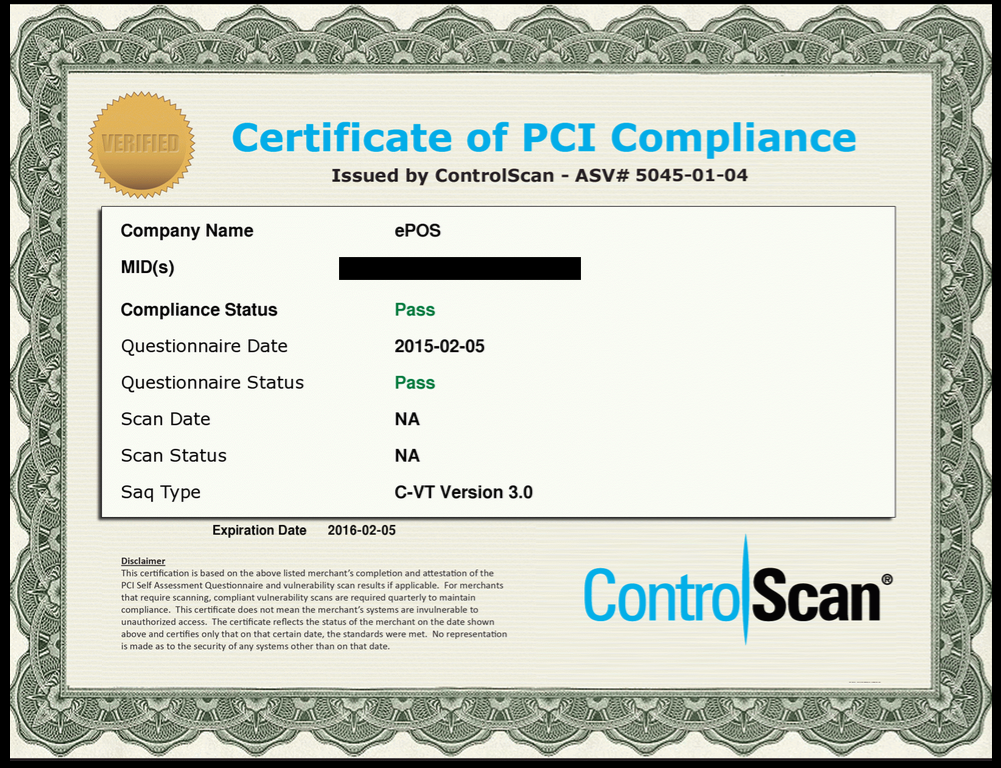
(Even we have to do it. See?)

Apple Pay
You may have heard a lot about Apple Pay. As a business owner, here's what you'll want to know.
What is Apple Pay?
It's a built-in application from Apple for iPhone 6 and 6-plus, that loads all your credit and debit cards right into your phone. Sound risky? Well anyone who stole your phone to use your cards would have to steal your fingerprints too. Here's what Apple has to say about their new application:
"Now paying in stores happens in one natural motion — there’s no need to open an app or even wake your display thanks to the innovative Near Field Communication antenna in iPhone 6. To pay, just hold your iPhone near the contactless reader with your finger on Touch ID. You don’t even have to look at the screen to know your payment information was successfully sent. A subtle vibration and beep let you know."
How Can I Accept Apple Pay?
ePOS now deploys Apple Pay compatible equipment as part of our Free Terminal Program for new customers.
That's it! If you would like to accept Apple pay, let us know and we'll hook you up.
Jason Hanson, ePOS
Gift Cards--Better than Vintage Paper Certificates?

Yes. Yes is the answer. They are way, WAY better. Here's why:
Paper certificates are difficult to market. If you put them on the countertop where everyone can see them and impulse buy, you're likely to lose them to shoplifters. But even idiot shoplifters know that gift cards are worthless until activated. So you can plant a big pretty display full of gift cards without risk. On display = impulse buying. Where are the paper certificate stored? In a drawer, where everyone forgets about them.
Paper certificates are paper. Let's face it; they don't look as good. If paper certificates were the better idea, then all the most profitable retailers in the world would be using them instead of pretty plastic cards. Which would you rather receive as a gift?
Tracking paper certificates is a nightmare. Electronic gift cards are automatically tracked and reported in a format that your bookkeeper will appreciate.
Electronic gift cards aren't expensive anymore. When they first came out for small businesses about 15 years ago, the average cost for a small merchant to set up a gift card trackng system including card production, was a little over $18,000. Now for a subscription fee of $60 per month (which includes the cards, design, terminal and tracking) you can sell gift cards to your customers.
Breakage. This refers to the 18% of all gift cards that are never redeemed. When a customer comes in with a paper gift certificate they expect change in cash if they don't use the full value. Major retailers have trained gift card consumers to just save the remaining balance for their next visit. Some people never come back, or they lose the card, making that money remaining on the card pure profit for the business. Others save the card for future use. And that makes for a return customer. Either way the business wins.
So gift cards are far more profitable for the business. They are far more appealing to the customer. They make the business 18% bonus profit in breakage. They are no longer expensive to produce and track. And finally they earn the business more customers.
I'm not just trying to sell my wares. Gift cards really do make a difference. But they're not for all businesses. Give us a call and we'll create a profit projection for your business.
Jason Hanson
ePOS
888-560-9025
Tablet Terminals-- Advancement, or Just a Pretty Face?
You see them at falafel trucks, ice creameries, and sandwich-eries. Maybe your coffee shop just got one.
Until the last 18 months or so, tablet credit card terminals were a bit janky. But fret not! Two things have happened since the first iPad was presented in 2010. First, the tablet is now way better. Seriously. Pick up an original iPad. It feels downright biblical (tablets...Moses...no?) Second, developers have beautified and streamlined their applications. They're actually a pleasure to use now.
Here are two offerings that in my opinion, represent the product type.
Oh, and just a note to clarify; we are considering the Tablet Terminal. By this we mean the tablet that is designed to replace a credit card terminal and cash register. It's not a full POS system like ShopKeep or LightSpeed. So here it goes:
In Square's case, the product is beautiful, simple, and works with most mobile devices. On the other hand, it's limited and not ready for complex retail inventory or a restaurant table-service environment. Some argue that's not Square's target market. And they're right. Square has made a name by targeting the small/mobile/quick-service-food-carts/handyman/home-service market. The rate of 2.75% is high at a glance. But the lack of other fees is compelling for small, low monthly volume businesses. It's basically a great rate if you process less than $10 average ticket. Merchants with average tickets above $10 and monthly volume over $7500 and you can score a net rate of around 2.00% including all other fees. Square came out of the gate in 2009, focusing on smartphones with some reader and app glitches. But updates and better phones and tablets soon led to smooth sailing.
PayAnywhere is similar product (that we actually offer). But to be objective, just like Square, it's not right for everyone. It's the same basic billing idea as Square for $12.95 per month and 2.69%. If you process over $5000 per month, you qualify for a loaner tablet from PayAnywhere (Square's stand is $99 plus the tablet). But again, like Square, it's limited. It is designed for the same basic market. Don't expect features like an employee time clock, advanced inventory tracking, table charts for your restaurant, or printed out tip lines. Oddly, in my experience, PayAnywhere actually runs better on Android tablets. The free tablet program is a Samsung encased in a credit card reader with a swivel base. A recent update has resolved glitches and added comprehensive billing explanation. Another nice change is that the advertisement to accept credit cards through PayAnywhere no longer appears on the customer's receipt. If you don't like the 2.69% + $12.95 fee structure, you can opt for a traditional account injected into the app.
Overall, the Tablet Terminal is better than an old fashioned credit card terminal.
1. They're faster.
2. Customers are used to them.
3. They will connect to a cash drawer and receipt printer.
4. That 16 year-old you just hired as a cashier already knows how to use it as he has a tablet or smart phone on his person. At this moment.
5. They're cheaper to operate and reduce paper consumption with email and text receipts.
6. Swiping a card through a dial terminal and waiting 12 seconds and spending 25 cents on the transaction fee alone before the percentage rate is very vintage. Why not prove you were there in '84 with a Cosby sweater, and save the money?
Jason Hanson, ePOS
The Importance and Strategy of Selecting the Right Merchant Services Company
Once you applied for a business license, did you notice all the calls and visits you suddenly received from Merchant Services (credit card processing) sales reps? They offer free terminals, fast customer service, quick funding, and low rates. In exchange, within minutes of speaking to this person, you are expected to share your business checking account number, social security number, EIN, home address, and virtually every other bit of personal and business financial information.
Surprisingly, this scenario happens many times every day, in nearly every city in North America. The majority of merchant services sales reps are honest and try to provide all they promise. But how secure is the information that the rep took from you? Did they leave your application forms in their car? When they reach their office, is your information locked up properly? Do they use a secure computer system when creating your account?
Beyond all these concerns, you are trusting the company you choose with the success of your business. If their network or equipment fails, how much business will you lose while you wait for customer service to resolve the matter completely?
To protect your company and make the right choice for merchant services, here are some recommendations:
1. Ask the sales rep who else uses their services in your industry and area. Does the rep hesitate or do they have references at the ready?
2. Never sign with a rep you just met (or spoke with on the phone). Take some time to Google their name and their company name. Ten minutes in front of your computer can save you thousands of dollars. Dishonest companies can never hide long from the Internet.
3. Don’t believe just one bad review. We’ve all seen that one difficult or unreasonable customer. Look at the merchant services company as a whole, and see what most people are saying to get a complete picture.
4. Don’t sign with a sales rep or company who talks negatively about other companies. Sales reps who speak ill of others often do so to hide their own bad reputation.
5. Call the merchant service company’s support line. How long does it take to get a human who speaks your language clearly?
6. Don’t go with a company that requires a contract. Many offer contract-free accounts. If there’s no contract, they must believe in their service quality to retain you as a client.
The facts are that many merchant service companies offer great products at great prices. If you use your instincts, do your research, and choose a company with experience in your industry, you’re likely to make the right choice.
-Jason Hanson, ePOS